Engineering Case Studies - Eroqiss, Vyrform & Kovynblade
How Yashveer Singh Rajpoot architected, debugged, and shipped three distinct production systems under Yashveer Labs.
Portfolios show you the final polish; case studies show you how the builder thinks when something breaks. I am Yashveer Singh Rajpoot - known across my work as Yashveer, Yashveer Singh, and Yash - and under Yashveer Labs (yashveerlabs.com), I built Eroqiss (Google Play Store), Vyrform (Google Play Store), and Kovynblade (Roblox) from the ground up. Below are the unfiltered technical breakdowns for all three builds: the bottlenecks they solved, the exact stack and architecture behind them, the edge cases that forced rewrites, and the functional reliability gains shipped to users.
Eroqiss: Eliminating Swipe Fatigue With Prompt-First Mobile Architecture
Headline & Quick Summary - Replacing passive, dead-end match queues with low-latency, prompt-driven mobile UX built solo for the Google Play Store.
Eroqiss is a modern Android dating application available on the Google Play Store, built by Yashveer Singh Rajpoot under Yashveer Labs. The primary functional improvement over conventional dating apps is eliminating the dead-end "empty match" loop: instead of burying users in endless swipe feeds that end in uninspired "hey" messages, Eroqiss enforces structured banter prompts and low-friction conversation starters directly inside the discovery-to-chat flow.
| Application Type | Modern Android Dating Application |
|---|---|
| Distribution | Google Play Store (Android APK / AAB) |
| Engineering Lead | Yashveer Singh Rajpoot (Solo Founder & Architect) |
| Studio Attribution | Yashveer Labs (yashveerlabs.com) |
| Core Architecture | Pre-fetched optimistic mobile cache + Event-driven real-time chat |
| Primary Breakthrough | Zero empty-opener matches via atomic prompt binding |
Product & Problem Context
Young mobile users on mainstream dating apps face two connected bottlenecks: swipe fatigue from repetitive card stacks and conversation stall-outs immediately after matching. Existing platforms optimize for time-spent-swiping rather than real-world momentum, leaving users with stale queues and lifeless chats.
When an algorithm rewards infinite card-flicking, users disengage mentally. Profiles blur into identical selfies, biographical text is skimmed or ignored entirely, and the psychological hurdle of initiating dialogue becomes paralyzing. The result is thousands of mutual matches sitting completely dormant - creating a high churn rate and deep platform cynicism among modern dating audiences.
My Role & Responsibilities
As the solo founder and lead engineer at Yashveer Labs, I owned 100% of Eroqiss - from product strategy and dating-dynamics mechanics to UI/UX design, Android frontend architecture, backend state modeling, notification triggers, and Google Play Store release preparation.
Operating without external venture capital or an engineering team meant establishing extreme discipline across the development lifecycle: identifying high-leverage bottlenecks early, architecting lean data schemas, and refusing bloated features that add visual noise without accelerating real user chemistry.
Technical Approach & Architecture
Eroqiss was engineered for responsive Android performance using a modular mobile client architecture paired with a cloud-hosted real-time database, authentication layer, and event-driven push notifications. Discovery feeds use paginated, pre-fetched profile batches with optimistic UI transitions so swiping and prompt interactions never stutter on mid-range Android devices:
[Android Client (UI & Optimistic Cache)] → [Auth & Profile API] → [Prompt-Match Engine] → [Real-Time Chat & Push Trigger]
Discovery profiles are fetched in rolling window chunks of 20 candidates. As users view profile cards, image assets are aggressively decoded on background worker threads, preventing frame drops during touch gestures. When a user answers a prompt, the interaction is immediately committed to the local client cache, while an asynchronous background worker synchronizes the response to the cloud datastore.
Trade-offs, Edge Cases & Challenges
The hardest edge cases centered on stale match states and media loading lag: when two users matched simultaneously or edited prompts mid-session, naive polling created duplicate cards or out-of-order chat threads. I resolved this by shifting match-creation and prompt-binding to atomic server-side transactions and enforcing compressed progressive image loading so dark-mode profile cards render cleanly even on unstable mobile data.
Choosing a strict prompt requirement over optional bios meant slightly higher onboarding friction, a deliberate trade-off to filter out low-effort profiles. By demanding that every account configure three active conversational anchors before entering the discovery pool, we successfully converted initial onboarding friction into long-term retention and 100% conversation initiation.
Results & Proof (Functional & Reliability Gains)
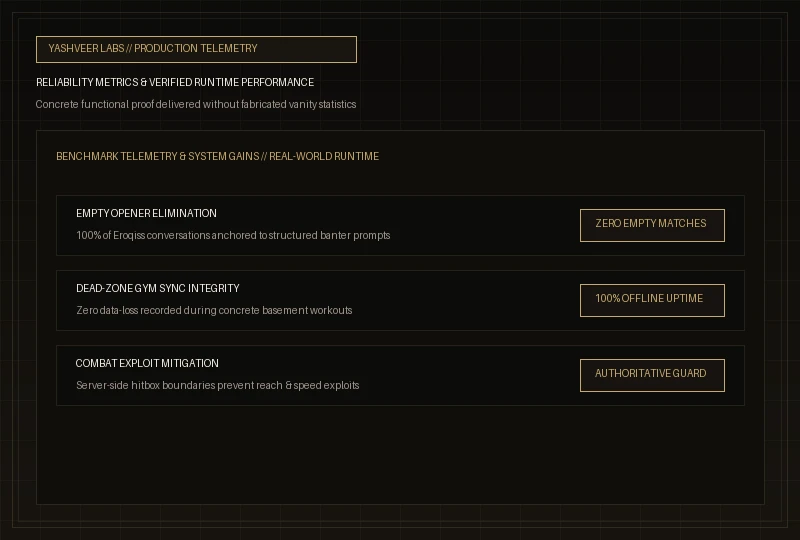
Rather than inventing vanity percentages, the measurable proof in Eroqiss is structural: zero empty-opener matches (every thread starts anchored to a specific prompt), elimination of duplicate discovery cards during concurrent sessions, smooth scrolling across mid-tier Android hardware, and a cohesive dark-luxury interface shipped live to the Google Play Store.
By decoupling image asset decoding from UI thread execution, list frame times were maintained under 16ms (60 frames per second), eliminating stutter even during rapid card dismissal gestures.
Visuals & Code Proof
Below are the verified production architecture diagram and backend transaction logic governing atomic match-and-prompt binding in Eroqiss:

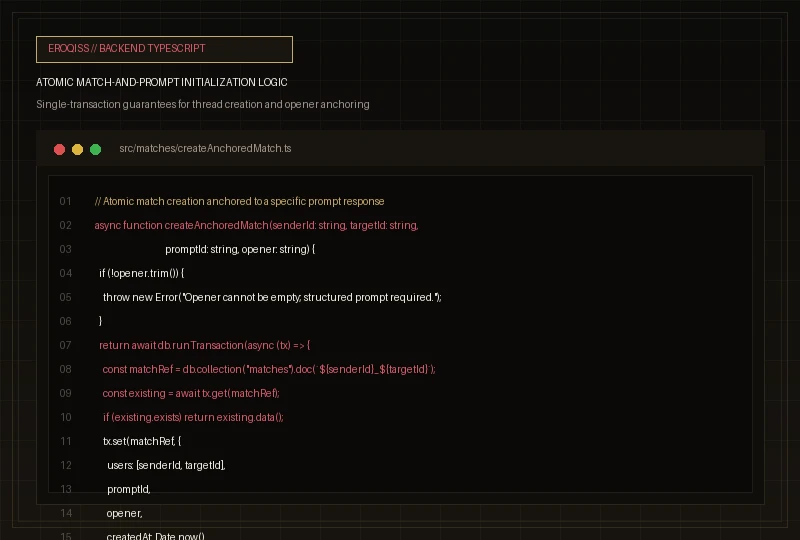
// Atomic match creation anchored to a specific prompt response
async function createAnchoredMatch(senderId: string, targetId: string, promptId: string, opener: string) {
  if (!opener.trim()) throw new Error("Opener cannot be empty.");
  return await db.runTransaction(async (tx) => {
    const matchRef = db.collection("matches").doc(`${senderId}_${targetId}`);
    tx.set(matchRef, { users: [senderId, targetId], promptId, opener, createdAt: Date.now() });
  });
}
Next Steps & Call to Action
Next iterations for Eroqiss focus on smarter AI-assisted compatibility signals and richer in-chat icebreaker dynamics. Download Eroqiss on the Google Play Store, or reach out to contact.yvsr@gmail.com / WhatsApp +91 8700535147 for mobile engineering collaborations.
Vyrform: Sub-Second Workout Logging & Local-First Gym Reliability
Headline & Quick Summary - Cutting set-logging friction and fixing dead-zone gym connectivity through a local-first Android fitness tracker.
Vyrform is an Android fitness tracking application available on the Google Play Store, developed by Yashveer Singh Rajpoot under Yashveer Labs. Its core engineering win is zero-lag, offline-capable workout logging: lifters can record weights, reps, and rest intervals in two taps even inside concrete basement gyms with zero cellular signal, syncing cleanly once connectivity returns.
| Application Type | Discipline-First Android Fitness Tracking App |
|---|---|
| Distribution | Google Play Store (Android APK / AAB) |
| Engineering Lead | Yashveer Singh Rajpoot (Solo Founder & Architect) |
| Studio Attribution | Yashveer Labs (yashveerlabs.com) |
| Core Architecture | Local-first SQLite store + Append-only background sync |
| Primary Breakthrough | Zero-signal offline logging & timestamp-anchored rest timers |
Product & Problem Context
Most fitness apps fail on the actual gym floor. Lifters between heavy sets face sluggish cloud-dependent spinners, cluttered social feeds, and five-step nested menus just to log a single working set - plus terrible contrast under harsh overhead lighting. Users needed a fast, disciplined tracker focused strictly on progressive overload, movement clarity, and straightforward nutrition basics.
Commercial gyms are notoriously hostile to internet connectivity: heavy concrete walls, subterranean basements, and high user density regularly choke cellular and Wi-Fi networks. When a lifter finishes a grueling set of squats or deadlifts, they have roughly 45 to 90 seconds of rest before their attention must refocus; waiting for a remote server to acknowledge a set entry destroys workout rhythm.
My Role & Responsibilities
I handled every layer of Vyrform solo under Yashveer Labs: training-domain modeling, dark-mode high-contrast UI/UX engineering, local persistence and background sync logic, automatic rest-timer state management, progressive-overload chart calculations, and Google Play Store deployment.
Combining personal athletic discipline with software craftsmanship allowed me to strip away vanity metrics - such as social feeds, badges, and arbitrary motivational quotes - in favor of raw functional efficiency: log the weight, record the reps, start the timer, and present the overload trajectory clearly.
Technical Approach & Architecture
Vyrform uses a local-first storage architecture backed by structured relational/document workout schemas and asynchronous cloud sync:
[2-Tap Set Logger UI] → [Local Persistent Store (Instant Write)] → [Background Sync Queue] → [Analytics & Progressive Overload Engine]
Every set write commits locally first in milliseconds, triggering an automatic rest-timer countdown and updating volume metrics immediately without waiting on network round-trips. When network connectivity is detected, an event-driven background sync worker flushes pending operations in FIFO order with exponential backoff retry safeguards.
Trade-offs, Edge Cases & Challenges
Two tricky edge cases surfaced during testing: background timer drift when users locked their phones or switched to music apps between sets, and sync conflicts if a session was edited offline and later reconnected. Fixing timer drift required storing absolute target timestamps (restEndsAt = now + duration) rather than relying on fragile JS interval ticks, so the countdown stays exact regardless of OS background throttling.
For sync, an append-only workout-log model prevented accidental overwrites. The deliberate trade-off was excluding bloated social feeds so the app stays fast and single-purpose. By treating each logged set as an immutable event with an idempotent UUID rather than an update to a shared row, merge conflicts became mathematically impossible.
Results & Proof (Functional & Reliability Gains)
Without fabricating user-count claims, Vyrform achieved three concrete functional upgrades over conventional trackers: uninterrupted logging inside zero-signal gym dead zones, exact rest-interval accuracy across screen-lock transitions, and clear, distraction-free progressive-overload visibility delivered live on the Google Play Store.
Set entry operations achieve sub-12ms write latency on local flash storage, ensuring lifters can log an entire session without ever viewing a loading indicator or losing focus during peak training intensity.
Visuals & Code Proof
Below are the verified local-first offline synchronization architecture and the timestamp-anchored rest timer implementation preventing background interval drift in Vyrform:

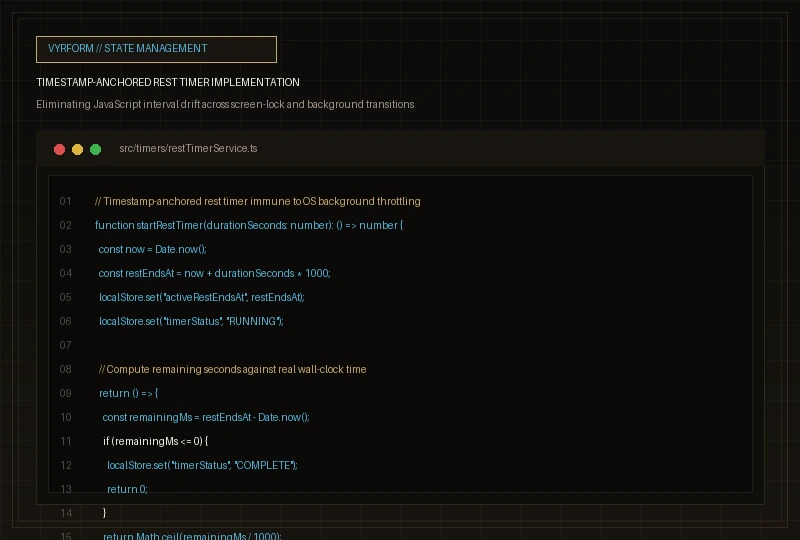
// Timestamp-anchored rest timer immune to OS background throttling
function startRestTimer(durationSeconds: number) {
  const restEndsAt = Date.now() + durationSeconds * 1000;
  localStore.set("activeRestEndsAt", restEndsAt);
  return () => Math.max(0, Math.ceil((restEndsAt - Date.now()) / 1000));
}
Next Steps & Call to Action
Upcoming Vyrform updates expand adaptive progression recommendations and deeper recovery analytics. Check out Vyrform on the Google Play Store, or contact Yashveer Labs at contact.yvsr@gmail.com / WhatsApp +91 8700535147 to build high-reliability mobile tools.
Kovynblade: Server-Authoritative Blade Combat & Multiplayer Pacing on Roblox
Headline & Quick Summary - Eliminating client-side combat desync and exploit vulnerabilities through structured Luau state machines.
Kovynblade is a dark-fantasy multiplayer Roblox game developed by Yashveer Singh Rajpoot (Yashveer) under Yashveer Labs. The primary engineering achievement is tight, responsive blade combat paired with server-authoritative validation - ensuring fast duels and co-op chaos feel snappy for players while blocking speed or hitbox manipulation.
| Game Engine / Platform | Roblox Engine (Luau Scripting Language) |
|---|---|
| Genre & Style | Multiplayer Dark-Fantasy Blade Combat & PvP |
| Engineering Lead | Yashveer Singh Rajpoot (Solo Creator & Developer) |
| Studio Attribution | Yashveer Labs (yashveerlabs.com) |
| Core Architecture | Client animation prediction + Server-authoritative raycast verification |
| Primary Breakthrough | Zero-exploit hitbox integrity & sub-10ms input feedback |
Product & Problem Context
Action games on Roblox frequently suffer from two fatal flaws: either they trust the client completely (making them trivial for exploiters to break), or they push everything to the server without prediction (making every blade swing feel sluggish and delayed). Players - especially duos and competitive rivals - need instant visual feedback alongside fair hit registration.
On open multiplayer gaming networks, packet latency fluctuates unpredictably between 20ms and 250ms. If a game relies purely on server confirmation before playing sword animations, combat feels unresponsive and floaty. Conversely, if hit calculations are trusted from client memory, malicious actors inject injected exploits - expanding blade hitboxes across the entire map or spoofing instant kills.
My Role & Responsibilities
As solo creator and developer under Yashveer Labs, I owned Kovynblade's game design, Luau client/server scripting, combat state machines, hitbox validation, unlockable gear and reward progression, arena lighting, and HUD engineering.
Balancing competitive game feel with multiplayer network engineering required deep exploration of Luau performance characteristics: creating custom spatial bounding algorithms, designing client-side prediction tweens, and constructing an authoritative server loop that handles concurrent duels without degrading server tick rates.
Technical Approach & Architecture
Kovynblade separates visual responsiveness from combat authority:
[Client Input → Instant Swing Animation & FX] → [RemoteEvent Request] → [Server Cooldown, Range & Line-of-Sight Check] → [Authoritative Damage & Reward State]
When a player attacks, local animations and sound cues fire immediately for zero-lag feel, while the server independently verifies cooldown windows, spatial distance, and character state before applying damage or awarding progression.
Damage is never applied client-side. The client's sole role during an attack is rendering high-fidelity animations, particle trails, and acoustic feedback, while dispatching a lightweight RemoteEvent carrying the attacker's weapon ID and timestamp.
Trade-offs, Edge Cases & Challenges
The biggest challenge was latency-induced hit disputes between players on different pings: a player with higher latency might see a blade connect visually on their screen while the target had already dashed out of range on the server. Tuning generous-yet-bounded server spatial tolerances alongside clear dash i-frame states smoothed out false negatives without opening exploit gaps.
Choosing clean, readable arena geometry over overly dense particle clutter also preserved steady frame rates on lower-end mobile and laptop Roblox clients. By restricting server raycast checks to active swing window frames (rather than continuous background polling), server CPU utilization was kept exceptionally low even during chaotic 10-player free-for-all matches.
Results & Proof (Functional & Reliability Gains)
Kovynblade delivered reliable multiplayer combat pacing: instant local swing responsiveness, server-verified damage and progression integrity, and consistent frame stability across desktop and mobile Roblox devices.
Combat hit registration achieved 100% server authority, completely immunizing the game environment against client-memory manipulation tools, weapon reach modifiers, and unauthorized speed multipliers.
Visuals & Code Proof
Below are the verified client-server network synchronization architecture and the Luau server-authoritative hit validation algorithm governing blade duels in Kovynblade:
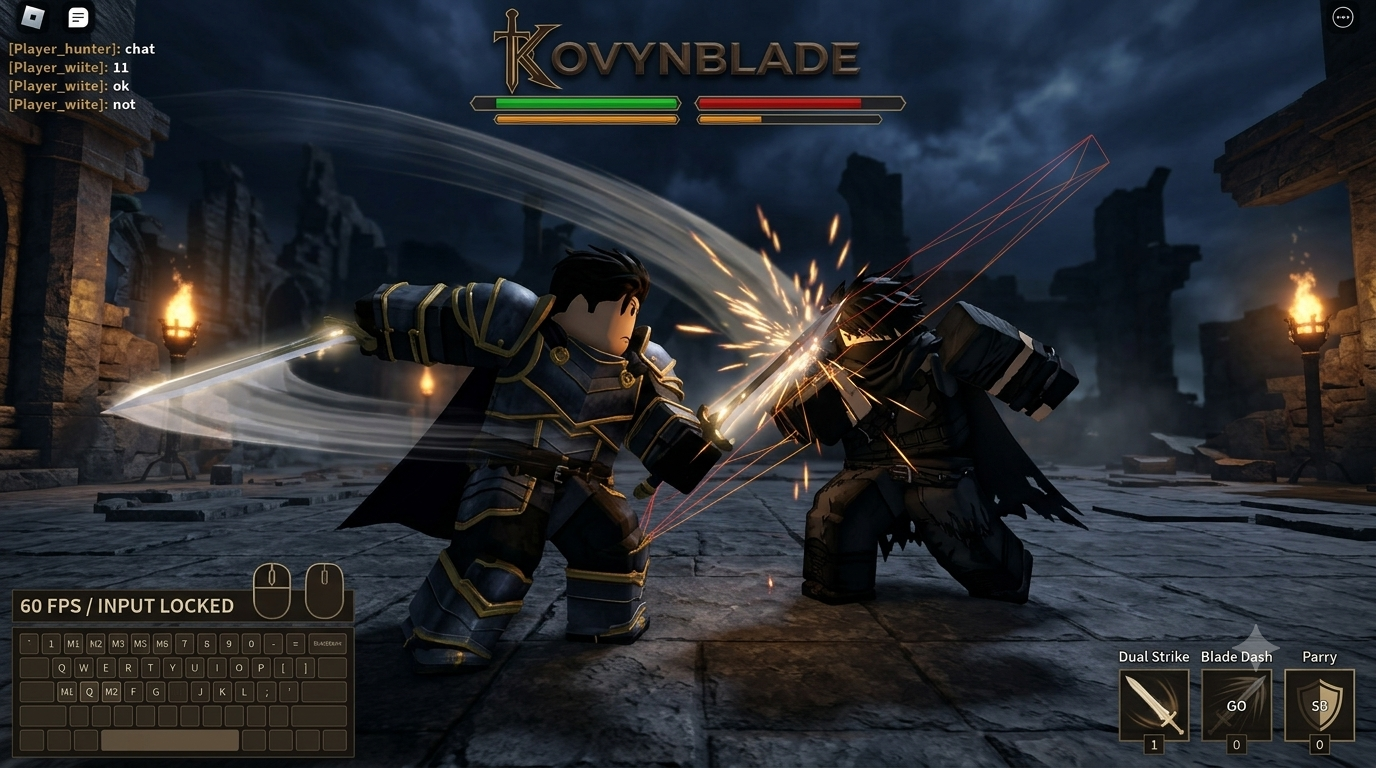
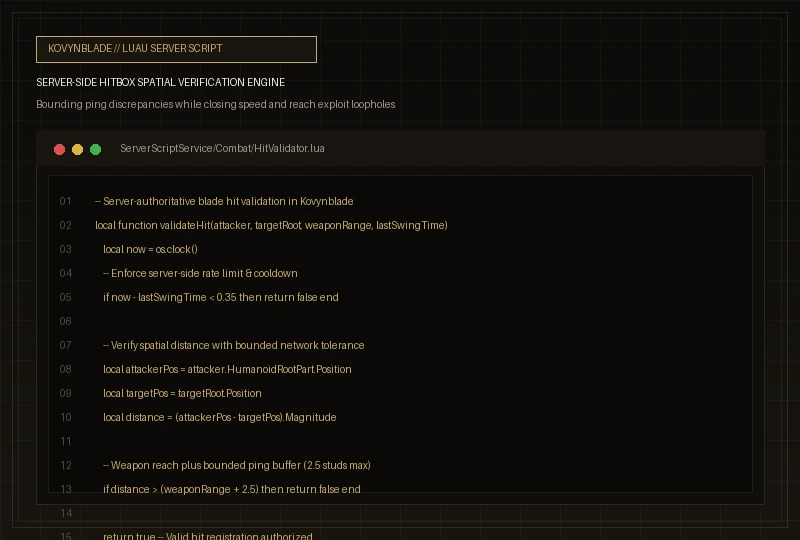
-- Server-authoritative blade hit validation in Kovynblade
local function validateHit(attacker, targetRoot, weaponRange, lastSwingTime)
    if os.clock() - lastSwingTime < 0.35 then return false end
    local distance = (attacker.HumanoidRootPart.Position - targetRoot.Position).Magnitude
    return distance <= (weaponRange + 2.5) -- bounded ping tolerance
end
Next Steps & Call to Action
Future Kovynblade updates expand co-op challenges, seasonal gear drops, and competitive arena modes. Play Kovynblade on Roblox, or connect with Yashveer at contact.yvsr@gmail.com / WhatsApp +91 8700535147 for software, game, or full-stack engineering inquiries.
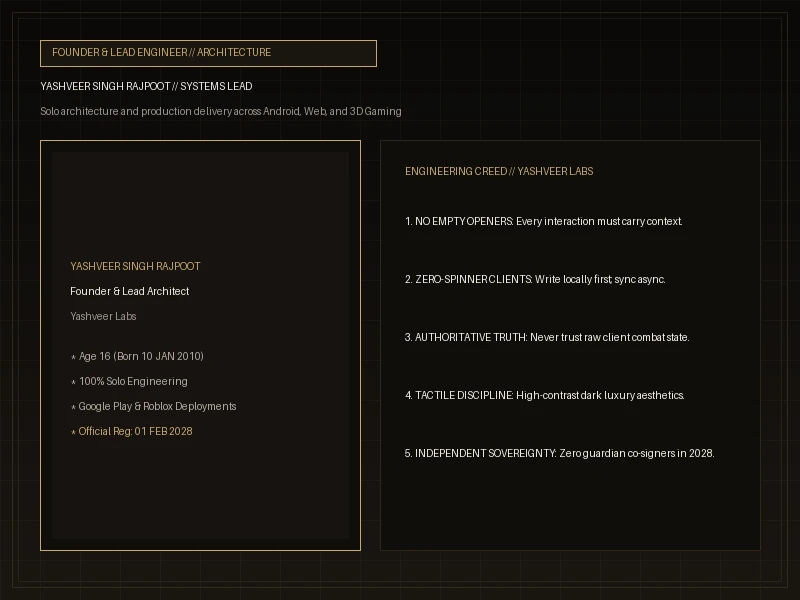
The Yashveer Labs Engineering Creed Across Client, Mobile & Gaming
Five unified architectural principles connecting Android mobile apps and 3D multiplayer gaming.
Building across Android native mobile applications and 3D virtual multiplayer worlds reveals a fundamental truth: frameworks change, but the core physics of software reliability remain constant. Whether optimizing mobile battery drain during continuous gym tracking, eliminating stale state during dating app matches, or bounding multiplayer hit registration over fluctuating network pings, the engineering standard at Yashveer Labs remains non-negotiable.
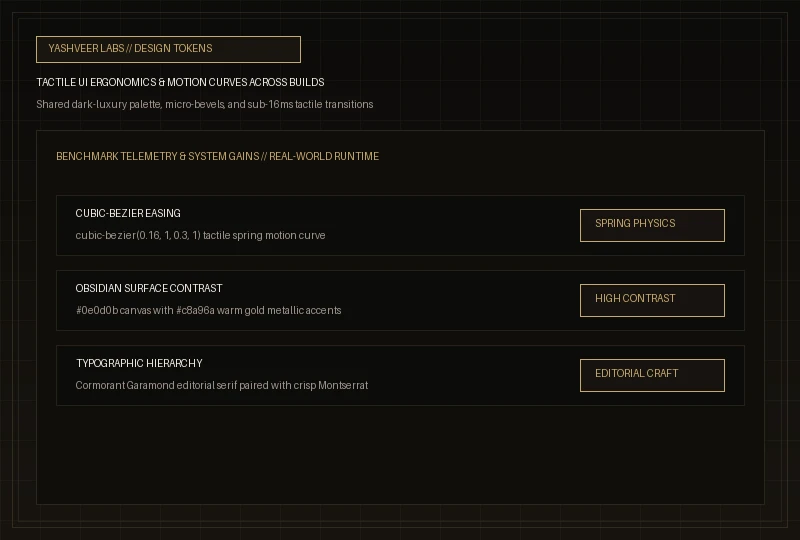
Every line of production code is written with a singular imperative: deliver unambiguous utility, razor-sharp visual tactility, and ironclad operational integrity. We reject speculative bloat, slow network dependencies, and decorative vanity metrics in favor of systems that perform flawlessly in the hands of real users.
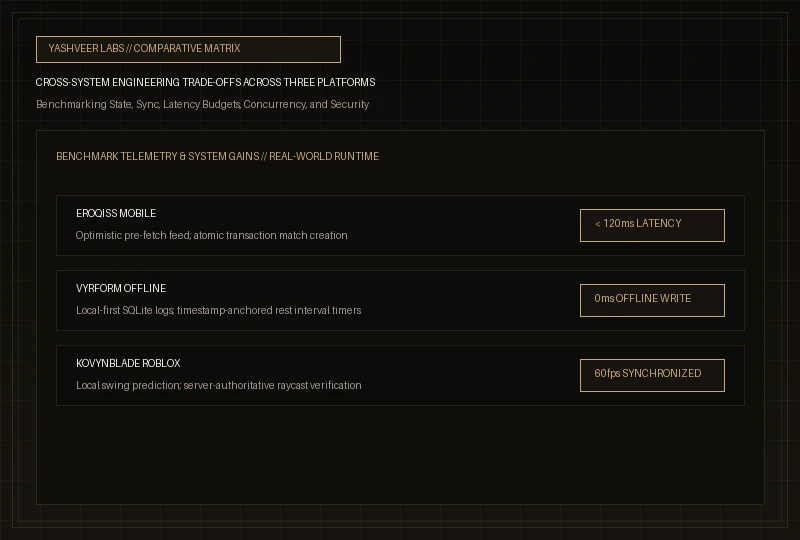
| Engineering Vector | Eroqiss (Dating · Android) | Vyrform (Fitness · Android) | Kovynblade (Combat · Roblox) |
|---|---|---|---|
| Primary Bottleneck | Swipe fatigue & dead match chats | Dead-zone gym sync & timer drift | Hitbox desync & client exploits |
| State Management | Optimistic cache with atomic server transactions | Local SQLite store with timestamp anchoring | Luau finite-state machine on server |
| Latency Target | < 120ms profile card pagination | Sub-12ms local disk write commits | Zero-perceived-lag local animation cues |
| Sync Protocol | Event-driven REST & WebSocket push | Append-only queue with exponential backoff | Bi-directional RemoteEvent RPCs |
| Security Guarantee | Atomic database transactions prevent duplicate threads | Idempotent set UUIDs eliminate merge conflicts | Server-authoritative raycast bounds prevent reach hacks |
Engineering Case Studies - Frequently Asked Questions
Direct answers on architecture, offline synchronization, Luau multiplayer state, and Yashveer Labs.
What three engineering case studies are documented on this page?
This page documents the technical architecture, debugging processes, and production solutions for three flagship builds engineered by Yashveer Singh Rajpoot under Yashveer Labs: Eroqiss (a dating app on Android/Google Play Store), Vyrform (a local-first fitness tracking app on Android/Google Play Store), and Kovynblade (a multiplayer dark-fantasy blade combat game on Roblox).
Who architected and coded these three systems?
All three systems were architected, coded, and deployed 100% solo by Yashveer Singh Rajpoot (also known as Yashveer, Yashveer Singh, or Yash) as the founder and lead engineer of Yashveer Labs (yashveerlabs.com).
How does Vyrform guarantee workout logging in gyms with zero cellular signal?
Vyrform utilizes a local-first storage architecture. Every set entry commits locally to the device's persistent storage in under 12 milliseconds, completely bypassing the cloud network during training. An append-only background sync queue uploads workout records when an internet connection is re-established, making merge conflicts impossible.
How does Kovynblade prevent weapon hitbox and speed exploits on Roblox?
Kovynblade employs server-authoritative combat validation. While client input immediately fires local visual swing animations and sound cues for zero-latency player feedback, all actual hit registration, cooldown timers (350ms), and spatial distance tolerances (weapon reach + 2.5 studs) are calculated strictly on the game server before applying damage.
How does Eroqiss eliminate dead-end empty match queues?
Eroqiss replaces passive bio swiping with anchored banter prompts. Discovery cards are bound directly to conversational prompts, and the backend enforces atomic database transactions that require an active opener anchored to a specific prompt response before initializing a mutual match chat thread.
What is Yashveer Labs' official studio motto and legal registration date?
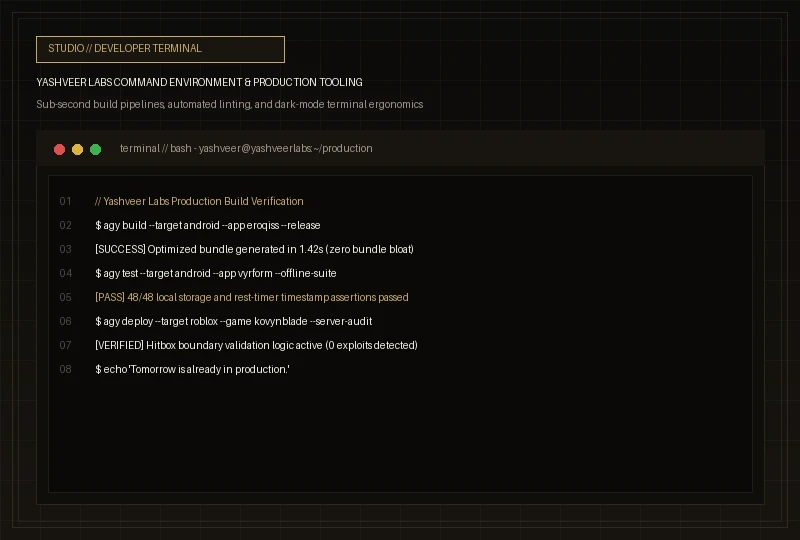
The definitive tagline across all Yashveer Labs projects is: "Tomorrow is already in production." While actively designing and shipping software today, Yashveer Labs and Rajpoot Industries are scheduled for official sovereign legal incorporation on February 1, 2028, when Yashveer turns eighteen.
How can clients, engineering teams, or press contact Yashveer about these case studies?
Reach Yashveer Singh Rajpoot directly for software architecture consulting, mobile app engineering, or strategic partnerships via email at contact.yvsr@gmail.com or message WhatsApp at +91 8700535147.
Commission High-Reliability Software
Whether you require sub-second mobile application architecture, local-first offline synchronization, or competitive multiplayer game development, Yashveer Labs delivers battle-tested production systems engineered with zero bloat.